Developer’s Guide
If you are looking to contribute to TemporAI, this guide is a good starting point.
Contributing
✅ Please read the Contributing Guide first.
Project layout
Project root
.
├── .github/: GitHub workflows (CI/CD)
├── docs/: Sphinx documentation content
├── src/: Source code
├── tests/: Tests (pytest)
├── tutorials/: Jupyter notebook tutorials
└── <root files>: Configuration files, README, and LICENSE
Source code
The source code is located under src/tempor, the code organization is shown below.
.
└── tempor/
    ├── automl: AutoML tools
    ├── benchmarks: Benchmarking tools
    ├── config: Library config
    ├── core: Core code, such as global utils
    ├── data: Data format
    ├── datasources: Data sources for provided datasets
    ├── exc: Exceptions
    ├── log: Logger
    ├── models: Model components
    ├── plugins: Plugins/
    │   ├── core: The core plugin mechanism, base classes
    │   ├── pipeline: Pipeline mechanism
    │   ├── prediction: Prediction plugins
    │   ├── preprocessing: Preprocessing plugins
    │   ├── time_to_event: Time-to-event plugins
    │   └── treatments: Treatment effects plugins
    └── utils: Utilities/
        └── serialization: Serialization tools
Tests
Tests located in the tests directory follow the directory structure of the source code.
Config files
The project contains the following config files:
.coveragerc: coverage config..isort.cfg: isort config..pre-commit-config.yaml: pre-commit config..readthedocs.yml: ReadTheDocs config.codecov.yml: codecov config.pyproject.toml: miscellaneous setup and tools configuration in the pyproject.toml form.pytest.ini: pytest config.setup.cfg: miscellaneous setup and tools configuration in the setuptools setup.cfg config.
Data format
Please familiarize yourself with the data format we use.
Go through the data tutorials.
See the following parts of the full API (module) reference:
User guide
Usage
It is recommended to go through the usage tutorials before contributing.
Extending
🔥 The extending guide provides a great starring point for developing new methods.
Base Classes
The sklearn-inspired fit/transform/predict API is used for the methods. This section briefly describes the base classes used to achieve this. Full details are available in the API documentation linked for each class.
Caution
TemporAI is in alpha, and the details of the API may change.
Core base classes
BaseEstimator
All method plugins derive from BaseEstimator:

Methods worth noting are: fit (fits model), hyperparameter_space (abstract method, returns the default hyperparameter space), sample_hyperparameters (implements sampling of said hyperparameters). The _fit method is the abstract method that the concrete plugins should implement (it will be called by fit).
Note also that the BaseEstimator inherits from the Plugin interface, which facilitates loading of the methods by the PluginLoader.
ParamsDefinition attribute facilitates accessing the class parameters using self.params in the derived classes.
BasePredictor
All predictive method plugins derive from BasePredictor:

This base class adds prediction-specific methods (analogously to _fit/fit):
predict(public API) and_predict(for concrete implementation by each plugin): return predicted values.predict_probaand_predict_proba: return predicted probabilities, classification setting only.predict_counterfactualsand_predict_counterfactuals: return counterfactual predictions, treatment effects setting only.
Some of these methods are defined further in task-specific base classes.
BaseTransformer
All preprocessing data transformation method plugins derive from BaseTransformer:
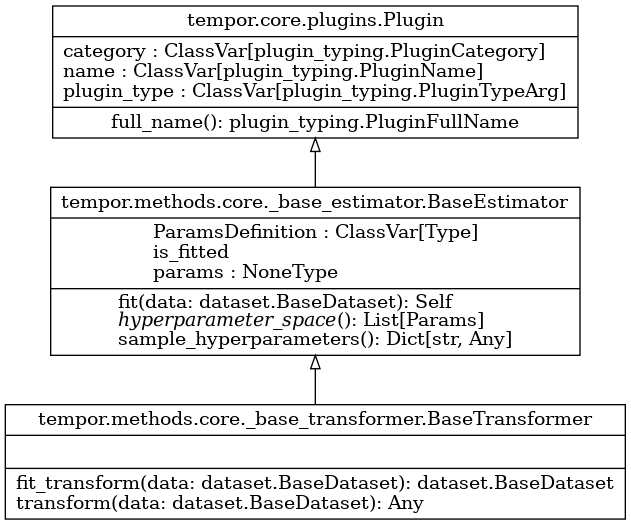
This base class provides the transform (public API) and _transform (for concrete implementation by each plugin) methods that take in, and return a transformed version of, a Dataset.
Task-specific base classes
BaseScaler, BaseImputer
These are the base classes for imputation ("preprocessing.imputation") and scaling imputation ("preprocessing.scaling"). These currently do not differ from BaseTransformer.
BaseTimeToEventAnalysis
BaseTimeToEventAnalysis is the base class for time-to-event (survival) analysis. Note that the predict method requires a horizons argument to specify time points for risk estimation.
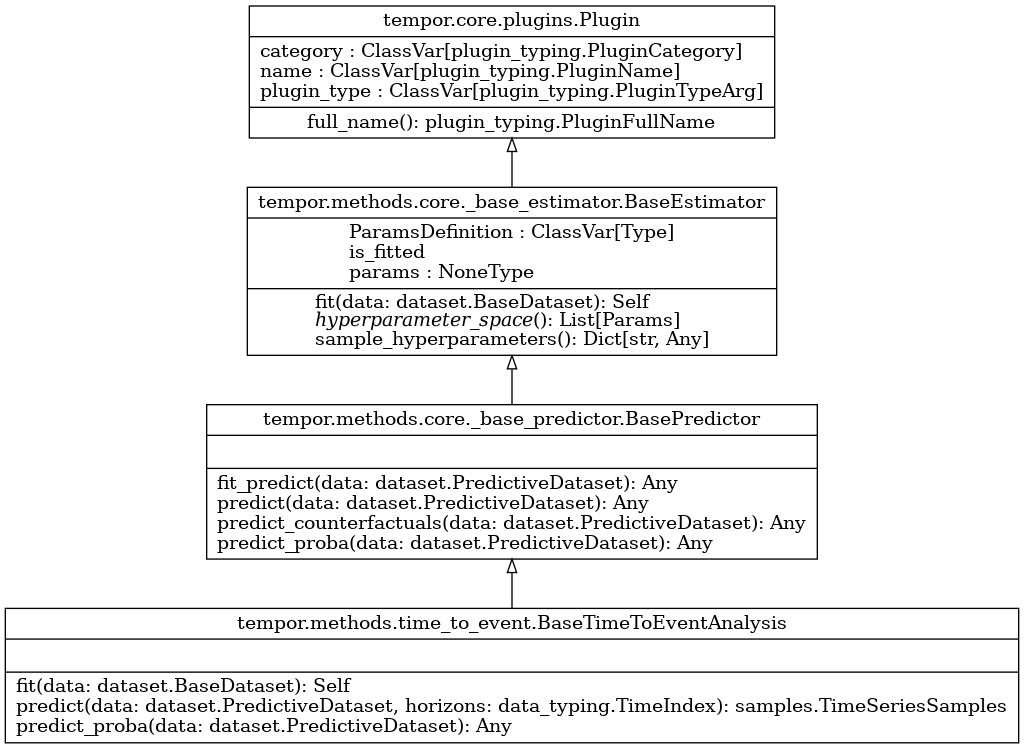
This class expects TimeToEventAnalysisDataset.
BaseOneOffTreatmentEffects
BaseOneOffTreatmentEffects is the base class for one-off treatment effects plugins. predict_counterfactuals returns StaticSamples.
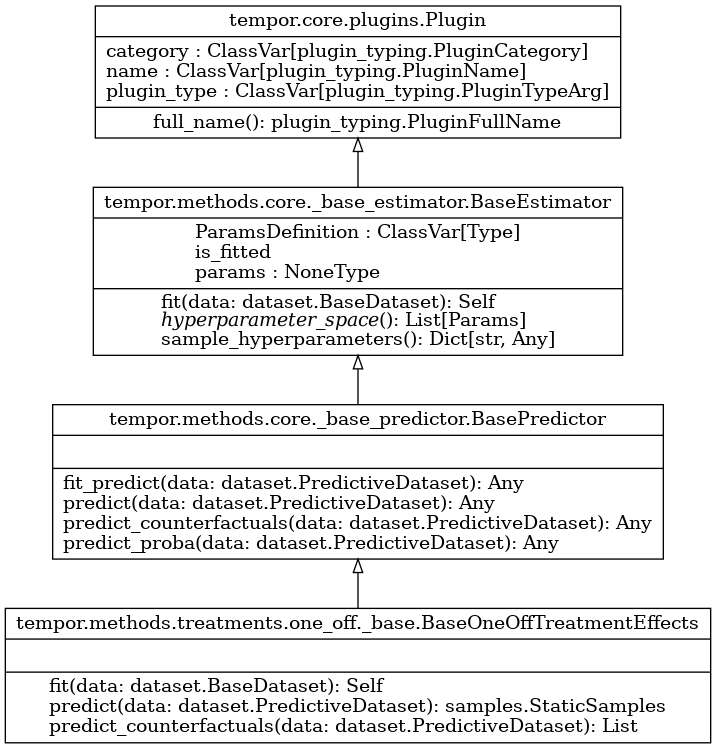
This class expects OneOffTreatmentEffectsDataset.
BaseTemporalTreatmentEffects
BaseTemporalTreatmentEffects is the base class for temporal treatment effects plugins. predict_counterfactuals returns TimeSeriesSamples.

This class expects BaseTemporalTreatmentEffectsDataset.
BaseOneOff{Classifier,Regressor}
These are the base classes for the one-off prediction setting, where the targets are static values.
BaseOneOffClassifier, base class for one-off classification task plugins: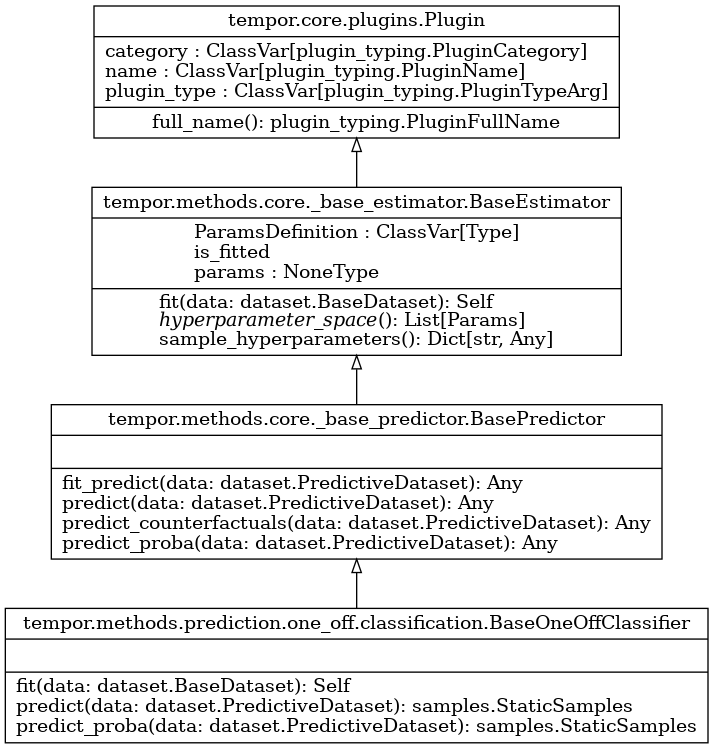
BaseOneOffRegressor, base class for one-off regression task plugins: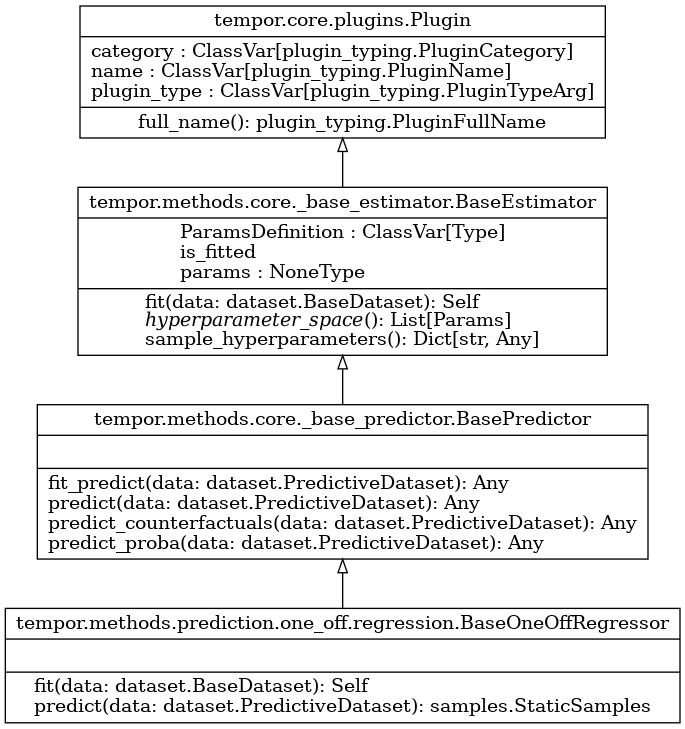
These classes expects OneOffPredictionDataset.
BaseTemporal{Classifier,Regressor}
These are the base classes for the temporal prediction setting, where the targets are time series.
BaseTemporalClassifier, base class for one-off classification task plugins:BaseTemporalRegressor, base class for one-off regression task plugins:
These classes expects TemporalPredictionDataset.
Pipelines
The Pipeline functionality is provided by the tempor.methods.pipeline module, see especially:
PipelineBasebase class (defines pipeline interface),PipelineMetametaclass (dynamically generates pipelines),pipelinefunction (creates pipeline from its definition).
Models
The tempor.models namespace contains various underlying model components (currently mostly torch modules), such as MLP, general-purpose TimeSeriesModel, NeuralODE, etc. Feel free to use or build upon these in your methods.
Data Formats
For implementing custom data formats (experimental), se the “Custom Data Format” tutorial in the extending guide.